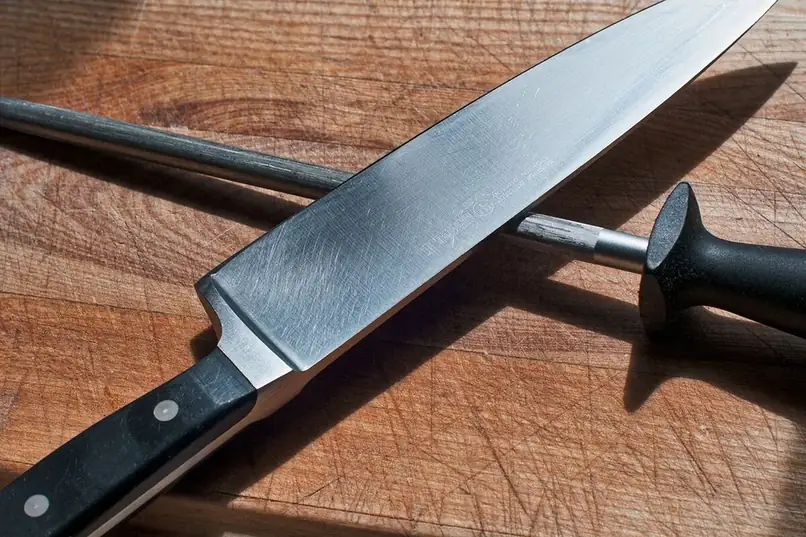
A sharp kitchen knife is safer, faster and more accurate than a dull one. Sharpening sounds intimidating, but the technique fits on one page: pick the right angle, keep it steady, move the blade across an abrasive surface, repeat both sides, finish on a fine grit, then polish on a steel rod before every use.
Hold the blade at 15 to 20 degrees against a wet whetstone, slide from heel to tip about ten times on each side at the coarse grit, then switch to a fine grit for another ten passes. Finish with a leather strop or a steel rod to remove the burr. The whole job takes 10 to 15 minutes once a year for a home cook.
The Sharpening Angle (Drawing)
The single most important thing in knife sharpening is the angle between the blade and the stone. Hold it consistently and the blade will sharpen no matter what stone you use. Wobble and you will round the edge instead.
Is My Knife Actually Dull? Three Quick Tests
Sharpening Method Comparison
| Method | Time | Skill | Edge quality | Wear on blade |
|---|---|---|---|---|
| Whetstone (2-sided) | 10-15 min | Medium | Best | Low (you control) |
| Pull-through manual | 1-2 min | None | OK | High (aggressive) |
| Electric sharpener | 3-5 min | Low | Good to very good | Medium-High |
| Honing rod (steel) | 30 sec | Low | Realigns only | None (no metal removed) |
| Diamond plate | 5-10 min | Medium | Very good | Medium |
| Pro service | Drop-off | None | Best | Medium |
Whetstone Sharpening, Step by Step
The whetstone is the standard answer for a home kitchen. A two-sided stone (around 1000 grit on one side, 6000 grit on the other) covers everything you need.
Soak the stone
Most water stones need 5 to 10 minutes in tap water until they stop bubbling. Diamond plates and oil stones do not soak. Read the label.
Place the stone on a non-slip surface
Use the rubber base if your stone has one; otherwise lay it on a damp folded towel. The stone moving mid-stroke is the fastest way to ruin a session.
Set the angle
For a western chef knife, aim for 15 to 20 degrees per side. The spine of an average chef knife is 4 mm thick; lifting the spine 4 mm off the stone gives you 15 degrees. If your knife came with a sharpening angle guide, use it.
Make consistent passes on the coarse side
With the blade pointing away, push the edge across the stone heel-to-tip with light, steady pressure. Two fingers of your free hand rest on the blade to keep the angle stable. About 10 passes. Flip and do the other side.
Check for the burr
Run a fingertip across the back of the blade from spine to edge. You should feel a tiny rough ridge (“burr”) forming along the entire edge. That means the coarse grit has reached the apex. If a section has no burr, do a few more passes there.
Repeat on the fine side
Same motion, lighter pressure, fewer passes (5-8 per side). The fine grit removes the burr and polishes the edge. Alternate sides every two strokes for the last set.
Finish on a strop or steel rod
One or two slow passes per side on a leather strop or honing rod aligns whatever is left of the burr. The knife is done.
Clean and test
Wash the knife with warm soapy water, dry it immediately to prevent rust, and try the paper test. Clean cut at zero downward pressure means success.
How to Hone (Between Sharpenings)
Honing is the maintenance you do every few uses. A steel rod does not remove metal; it pushes the bent microscopic edge back into a straight line. That is what makes a kitchen knife feel fresh again two months after a real sharpening.
- Hold the rod vertically with the tip resting on a cutting board, handle at the top.
- Place the heel of the blade against the rod near the top, at 15 to 20 degrees.
- Slide the knife down and toward you, keeping the angle, until the tip reaches the bottom of the rod.
- Switch sides and repeat. 6-8 alternating passes is plenty.
Common Mistakes
Angle by Knife Type
| Knife | Typical angle per side |
|---|---|
| Western chef knife (German style) | 18-20° |
| Japanese chef knife (gyuto, santoku) | 12-15° |
| Japanese single-bevel (yanagiba, deba) | 10-12° on one side, 0° on the back |
| Paring knife | 15-20° |
| Boning / fillet knife | 17-20° |
| Bread (serrated) | Sharpen each scallop with a tapered rod, not on a stone |
| Cleaver | 22-25° (more durable, less surgical) |
When to Use Each Method
Authoritative References
- Wüsthof care and sharpening guide: Wüsthof knife care
- Shun (Japan) sharpening guide: Shun sharpening knives
- America’s Test Kitchen video and notes on knife sharpening: America’s Test Kitchen
FAQs
How often should I sharpen my kitchen knives?
Once or twice a year is enough for a home cook who hones between uses. Heavy users or pro kitchens sharpen monthly. The signal is when honing no longer brings back the edge.
What is the difference between honing and sharpening?
Honing realigns the existing edge with a steel rod and removes no metal. Sharpening removes a thin layer of metal on a stone or other abrasive to create a new edge. Hone often, sharpen rarely.
Whetstone, pull-through or electric sharpener?
Whetstone produces the finest edge, takes the most skill and the most time. Pull-through is fastest but removes too much metal. Electric is the easy middle ground; quality models work well.
What angle should I sharpen a kitchen knife at?
Western chef knives: 15-20 degrees per side. Japanese knives: 10-15 degrees per side. When in doubt, follow the manufacturer manual.
How do I know my knife is sharp?
A sharp knife slices a piece of paper held mid-air cleanly, and shaves the tip off a tomato with zero pressure. Dull blade tears the paper or skids on the tomato skin.
Can I sharpen serrated knives?
Yes, but only with a tapered ceramic rod or a serrated-specific sharpener, working each scallop from the back side. A whetstone or pull-through ruins serrations.
Final Answer
Sharpen at 15 to 20 degrees on a wet whetstone, alternate sides until you feel a burr, polish on a finer grit, finish on a steel rod. Hone routinely between full sharpenings. Hand wash, dry and store on wood or in a block. A well-cared-for chef knife stays scary-sharp for years on this routine.
For more practical home and tech how-tos see our guides on best adjustable dumbbells, 48 inches in feet conversion, how many quarts in a gallon and fixing a slow Mac startup. While you are organizing the kitchen, lock down the smart-home accounts with our Free Password Strength Checker.
 English
  German
  Danish
  Italian
  Swedish
  Romanian
  Thai
Thai  Vietnamese
  Japanese
  Dutch
Dutch  Korean
  Arabic
  Hungarian