AI-Staffing Promises to Solve Security Recruiting, But Only If You Bring the Right Scrutiny
iunie 03, 2026 • César Daniel Barreto
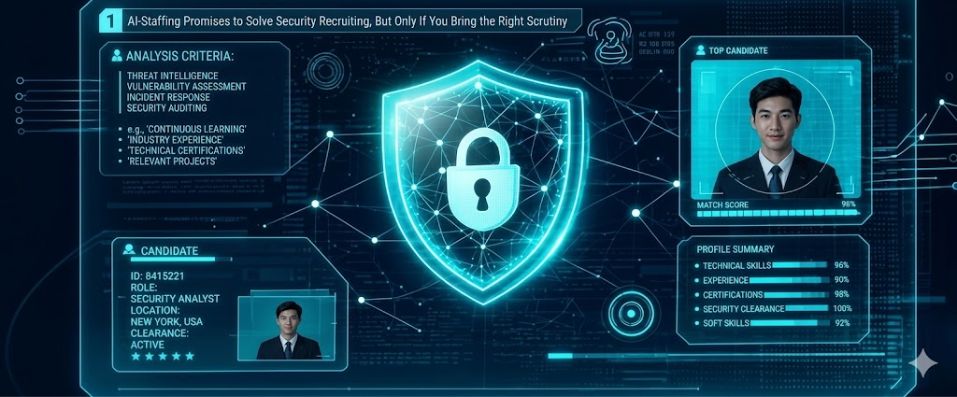
Hiring qualified cybersecurity talent has become one of the hardest problems facing IT organizations today. Open positions stay unfilled for months, salary expectations climb relentlessly, and the competition for senior analysts, incident responders and cloud security engineers leaves most teams permanently understaffed.
In this context, the temptation to improve outreach with AI-staffing is real, particularly for security leaders who watch their hiring pipelines stagnate while threats keep evolving. But what does this kind of technology actually deliver, and what should a security-minded organization look at before deploying it?
Why Security Recruiting Has Become a Structural Problem
A talent shortage with no quick fix
The gap between demand and supply in cybersecurity talent is no longer a temporary imbalance, it is the new baseline. Global estimates have been pointing to millions of unfilled cybersecurity positions for years, and the trend is not reversing.
Senior incident responders, SOC analysts with cloud experience, and engineers familiar with modern detection stacks are particularly scarce. For most organizations, the issue is no longer whether to invest in better recruitment processes, but how fast they can do it before their security posture suffers.
Traditional outreach struggles to keep up
Conventional sourcing methods, built around LinkedIn searches, recruiter cold emails and referral programs, were designed for markets where qualified candidates could be reached with reasonable effort.
They struggle visibly in cybersecurity, where top profiles receive dozens of unsolicited messages per week and tune out generic outreach almost immediately. Personalization at scale becomes the bottleneck, and most internal teams simply lack the bandwidth to engage each potential candidate with the depth required to stand out.
What AI-Staffing Actually Brings to the Table
Smarter candidate identification
The first concrete contribution of AI-staffing tools is in how they parse and rank candidate profiles against precise job requirements. Beyond keyword matching, modern tools analyze career trajectories, technology stacks used in previous roles, and signals of practical experience that traditional searches miss. For specialized profiles like penetration testers or threat hunters, the difference between a tool that surfaces five strong candidates and a manual search that yields none can be substantial.
Personalized outreach at scale
Generic recruiter messages have become so widespread that they barely register. AI-staffing platforms can generate personalized first contact messages that reference specific aspects of a candidate’s career, recent contributions to open-source security projects, or technologies they have worked with.
When implemented well, this approach significantly improves response rates compared to mass templated outreach. The caveat lies in maintaining authenticity rather than producing personalization that feels mechanical or formulaic.
Pipeline management and follow-up automation
Beyond first contact, these tools help manage the long tail of follow-ups, scheduling and candidate journey tracking that often falls through the cracks in busy security organizations. Candidates who would otherwise drift away from slow pipelines stay engaged, and recruiters or hiring managers focus their attention on interactions that genuinely require human judgment.
The Scrutiny Security Leaders Must Apply
Data handling and regulatory compliance
This is where any security-aware organization must slow down and ask the right questions. Candidate data is personal data, and its processing falls under GDPR in Europe and equivalent frameworks elsewhere.
Before adopting an AI-staffing platform, security teams should examine where candidate information is stored, who has access to it, how long it is retained, whether it leaves the EU when relevant, and how consent is obtained for automated processing.
Vendors that gloss over these questions or provide vague answers should raise immediate red flags, regardless of how impressive their feature set looks.
Algorithmic bias and decision transparency
AI tools trained on historical hiring data can inherit and amplify biases present in past decisions, which becomes a legal and reputational risk. For a security organization that prides itself on rigor and accountability, deploying a tool whose decision logic remains opaque conflicts with the same principles applied elsewhere in the stack.
Look for vendors that document how their models are trained, what bias mitigation measures are in place, and how human review remains integrated in the recruiting decisions that matter most.
Integration with existing security controls
An AI-staffing platform that processes sensitive candidate information becomes part of the organization’s data perimeter, and should be evaluated with the same lens applied to any other vendor. Single sign-on integration, audit logging, encryption at rest and in transit, vulnerability disclosure history, and SOC 2 or ISO 27001 compliance all deserve verification.
The temptation to bypass security review for a tool that promises to solve a painful business problem is understandable, but inviting in a vendor with weak posture creates exactly the kind of supply chain risk that security teams spend their time mitigating elsewhere.
Practical Steps Before Deploying
Adopting an AI-staffing platform should follow the same procurement discipline as any other security-sensitive vendor. Run a structured evaluation involving both HR and security stakeholders from the start, rather than treating it as a recruiting decision with security review added late.
Request demonstrations on real candidate profiles relevant to your hiring needs, not generic showcase data prepared for sales calls. Validate compliance documentation early, ideally before committing significant time to technical evaluation.
Plan a controlled pilot before broad deployment. Limit initial usage to specific roles or teams where measurable success criteria can be established, such as response rate improvements, time-to-hire reductions or candidate quality assessments by hiring managers.
This pilot phase also serves to surface integration friction, workflow misalignments and any concerns from candidates that may emerge from automated outreach. A vendor that cooperates fully with this evaluation approach is one worth partnering with for the long term.
A Tool Worth Adopting, With Eyes Open
In the end, AI-staffing is neither the silver bullet some vendors describe nor the threat some critics fear, but a category of tools that can materially improve security hiring when adopted with appropriate scrutiny.
The organizations that benefit most are those that combine genuine openness to the technology with the same rigor they apply to the AI-driven defenses already reshaping their security operations, treating the recruiting pipeline as critical infrastructure rather than as a separate operational concern.
Done well, this approach addresses the talent shortage without creating new risks, which is exactly what security-minded buyers should expect from any modern tool they bring into their environment.

César Daniel Barreto
César Daniel Barreto este un apreciat scriitor și expert în securitate cibernetică, cunoscut pentru cunoștințe aprofundate și capacitatea de a simplifica subiecte complexe de securitate cibernetică. Cu o vastă experiență în securitatea și protecția securitate a rețelelor și protecția datelor, contribuie în mod regulat cu articole perspicace și analize privind cele mai recente tendințe în domeniul securității cibernetice, educând atât profesioniștii, cât și publicul.
 Romanian
  English
  German
  Danish
  Italian
  Swedish
  Thai
Thai  Vietnamese
  Japanese
  Dutch
Dutch  Korean
  Arabic
  Hungarian